
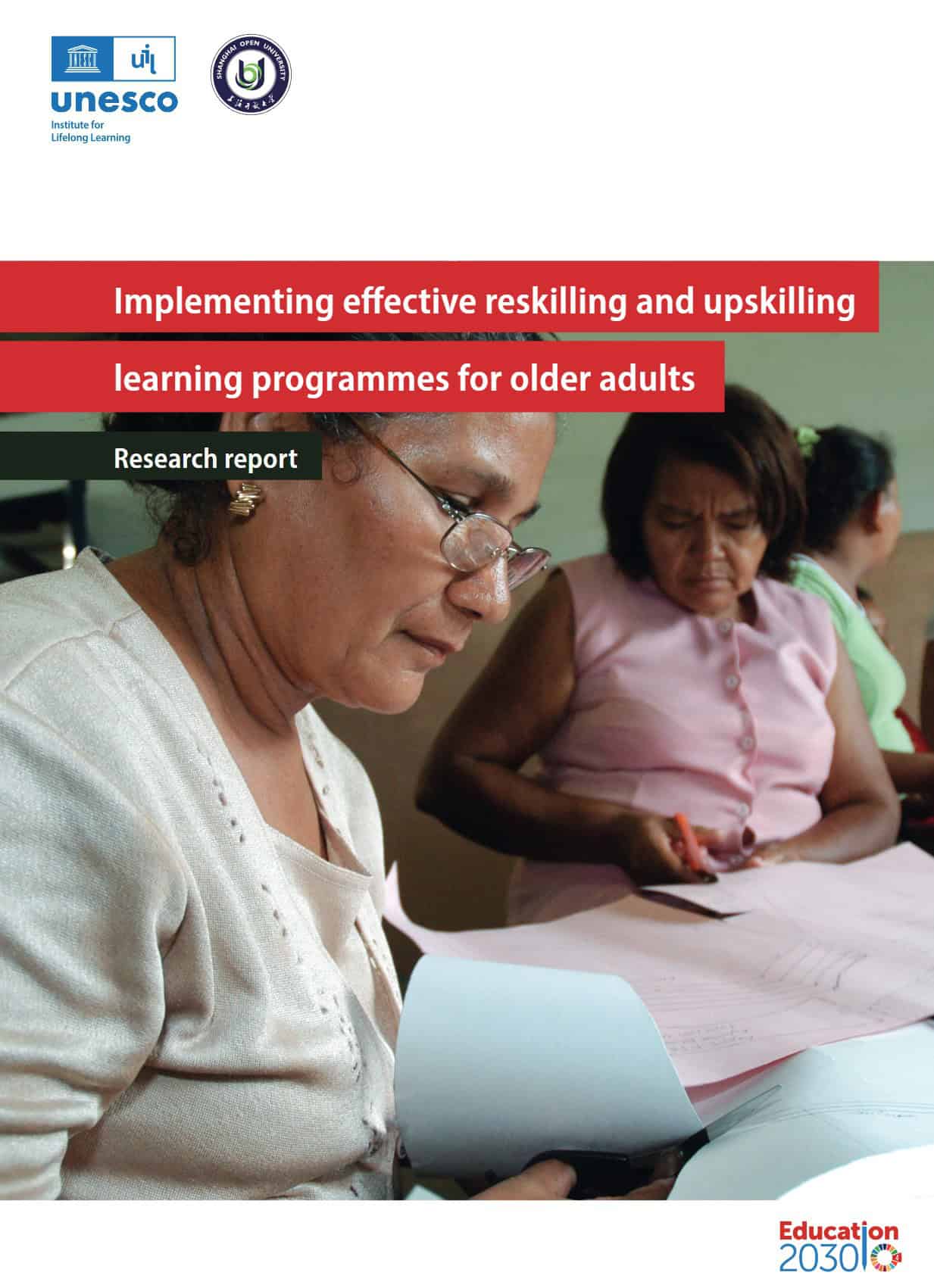
Although such programmes help older adults keep pace with technological developments and secure their employability, the UNESCO study ‘Implementing effective reskilling and upskilling: learning programmes for older adults’ highlights that many participants continue to face fundamental challenges.
These include, in particular, a mismatch between existing qualifications and new requirements, difficulties in coping with technological change, and widespread age discrimination in the application process. Added to this are often internalised self-doubts, which lead older people to perceive themselves as ‘too old’ for further training or new career prospects.
Funding as a key obstacle
The study analyses and compares innovative approaches from Colombia, Japan, Singapore, Sweden and the USA.
Financing represents a key obstacle in this regard. In several of the countries examined, there is a lack of sufficient financial support during participation in further education programmes. In some cases, participants only receive remuneration once they have found employment again, which can have a negative impact on motivation. Limited funding periods or a lack of government grants also mean that many older adults are reliant on their own resources or family support. These financial barriers not only restrict access but also increase the risk of dropouts.
The study also shows that motivation and participation depend heavily on the individual’s starting point. It is particularly challenging to engage people who have been out of work for a long time or have little work experience. In contrast, participants in more formal educational settings, such as universities, often demonstrate higher levels of motivation. A target group-specific approach, supportive learning environments and financial security therefore play a decisive and encouraging role in participation.
Age discrimination in companies and society
Another key finding concerns the role of age discrimination. This not only acts as a barrier to entry but also influences the overall effectiveness of programmes. It manifests itself both in companies’ recruitment practices and in societal stereotypes and internalised self-perceptions among older adults. This makes the transition from continuing education to the labour market considerably more difficult. Programmes that specifically build bridges to employment – for example, through internships or job placement services closely linked to the labour market – prove particularly effective in this regard.
Further education yields positive effects
At the same time, the case studies analysed demonstrate that further education can achieve significant positive effects. In the USA, for example, participants were able to move directly into employment, whilst in Colombia thousands of graduates were trained and numerous start-ups were established. Concrete employment and income effects are also evident in Japan and Singapore. At the same time, in some contexts it remains unclear how sustainable the impact of continuing education is on labour market integration, as relevant data is lacking.
Beyond economic effects, the study highlights the social and personal impact of continuing education. Programmes help to reduce isolation, strengthen social networks and promote social engagement. Face-to-face formats and community-oriented learning settings in particular support these effects. Many participants also report increased self-confidence and improved ability to handle new technologies as well as changes in their life circumstances.
Cooperation as a key success factor
UNESCO identifies a combination of political support, institutional cooperation and design tailored to the target group as key success factors. Effective programmes emerge particularly where education providers, employers and government bodies cooperate closely and jointly develop labour market-relevant programmes. Entrepreneurship is also highlighted as an important approach, as it opens up new forms of economic and social participation for older adults.
At the same time, the study points out that older adults do not constitute a homogeneous target group. Differences in education, income, employment histories and life circumstances require tailored provision. Particularly disadvantaged groups – such as the low-skilled, people on low incomes or women with interrupted employment histories – often benefit most from continuing education, yet have the least access to it.
Recommended: flexible provision
To design effective programmes, UNESCO recommends flexible and personalised learning formats that take into account different needs and learning requirements. These include blended learning, individual support and practical content. Equally important is the active involvement of older adults in the development of provision, to better take their perspectives and motivation into account.
Last but not least, the study highlights the need to systematically combat age discrimination. In addition to raising awareness and establishing appropriate policy frameworks, concrete incentives for employers are also required to promote the recruitment and upskilling of older workers. Intergenerational learning formats can further help to break down stereotypes and strengthen knowledge transfer.
Overall, the analysis shows that continuing education for older adults has great potential, but that this can only be realised if structural barriers are removed, programmes are consistently tailored to the target group, and transitions into the labour market are actively supported.


