The success of EPALE is clearly reflected in further successful intergovernmental collaborations providing us with valuable experiences we can all learn from. The Nordic Network For Lifelong Learning (in short: NLL formerly known as NVL), is an excellent example of international cooperation to improve adult learning policy and practice with a regional focus.
The Nordic Network for Lifelong Learning (NLL), established by the Nordic Council of Ministers (NCM) in 2005, unites all the Nordic countries and works according to the strategy of the NCM on adult educators’ competence development, VPL (validation of prior learning), lifelong guidance, education for sustainable development, basic skills development. NLL is responsible for creating and coordinating thematic networks with the goal to gather evidence about as well as compare the situation in different fields of adult education in the Nordic region. The results from NLL work support the development of policy and practice of adult learning. NLL strives to involve both education organisations and social partners in the dissemination and development activities.
The following interview was conducted by Tamás Harangozó, editor at the European Basic Skills Network and EPALE Adult Learning Expert, and is dedicated to the 10th anniversary of EPALE. We invited different regional coordinators from NLL to ensure a holistic view on EPALE’s role in the Nordic cooperation. The insights given in this interview reflects three experts’ views: Antra Carlsen – head coordinator, Johanni Larjanko – national coordinator for Finland, and Andreas Gravdahl – national coordinator for Norway.
NLL’s role in EPALE’s development
Over the past decade, how has The Nordic Network for Lifelong Learning contributed to shaping discussions and policies on EPALE? Can you highlight a key initiative or collaboration where NLL’s expertise made a significant impact?
The Nordic Network for Lifelong Learning and EPALE have collaborated in various ways to promote lifelong learning, skills development, and policy innovation across Europe. This partnership has been valuable in addressing challenges like digitalisation, inclusion, sustainability, and skills validation.
The NLL-EPALE cooperation over several years has strengthened lifelong learning policies, networks, and innovations in both the Nordic region and the broader European landscape.
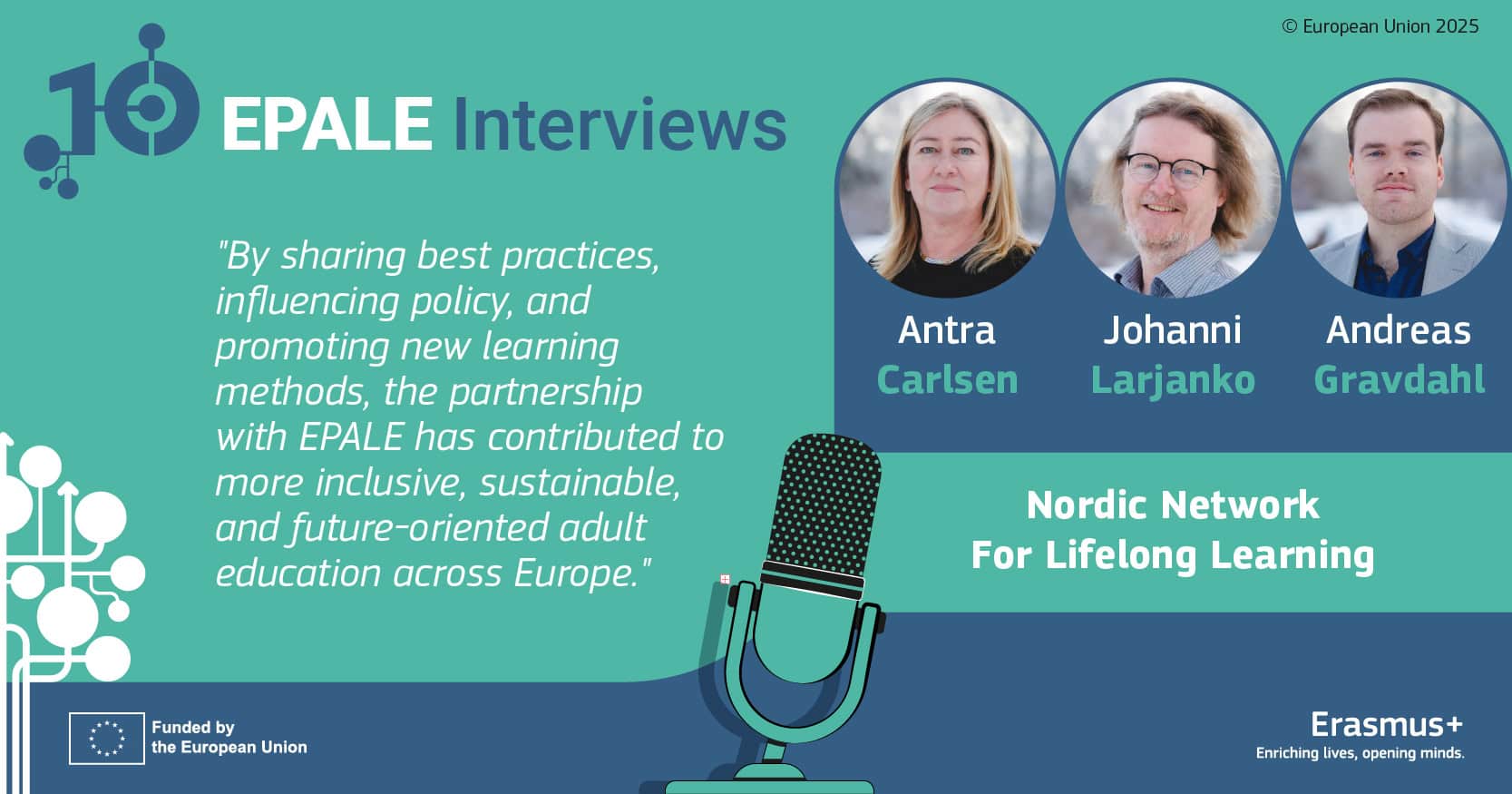
By sharing best practices, influencing policy, and promoting new learning methods, this partnership has contributed to more inclusive, sustainable, and future-oriented adult education across Europe.
Nordic Approaches in European Policy
How has NLL helped integrate Nordic perspectives on lifelong learning into EPALE’s broader European policy discussions? Are there specific themes, such as sustainability, digital learning, or inclusion, where NLL’s influence is particularly visible?
Knowledge sharing and learning practice sharing have been essential for creating synergies and linking Nordic perspectives with broader European perspectives.
NLL’s research and thematic reports on competence development, green transition, and digital learning have been widely shared through EPALE. EPALE has provided a platform for Nordic educators and policymakers to publish case studies and insights that can be applied in a European context.
NLL has contributed expertise to EPALE’s work on digital transformation, inclusion, and work-based learning. The Nordic Thematic Landing Page on Digital basic skills of adult learners serves as a guiding reference (author: Jenni Westö).
Furthermore, Nordic experiences in non-formal adult education and validation of prior learning (VPL) have helped in shaping European strategies. One milestone publication in this field was the comprehensive policy recommendation titled Liberal adult education certificate as a tool for validation (available also in Finnish and Swedish).
Finally, the sharing of PIAAC follow-up experiences has just started. A vast amount of data on the knowledge levels among adults is available in the PIAAC2 survey. The main findings can be summarised in four lines, but there is much, much more to be gained from the results of large-scale interviews with 4,000 respondents (Norway) aged 16 to 65.
Strengthening Cross-Border Collaboration
NLL is known for fostering cross-border cooperation in adult learning. How has EPALE supported NVL in connecting Nordic adult learning strategies with wider European networks? Can you share examples of successful partnerships or knowledge-sharing efforts?
Cross-border learning events, like webinars, workshops, and seminars organized jointly have helped spread Nordic innovations in adult learning (e.g., competence-based learning, sustainability education). EPALE’s extensive reach across Europe has enabled Nordic best practices to influence policies and strategies beyond the region.
NLL Norway has actively cooperated with EPALE Norway on several events, including both the Læring i nord annual conference (in English: Learing in the north), and the DigiNorden conference in Tromsø, Norway, September 2022. Both organisations have jointly gathered all the information needed on the selected topics presented in the conferences, and contacted the relevant stakeholders, resulting in both obtaining new knowledge for our host organization and main organisation; also acquiring new contacts and a greater network for future events and projects. The event’s goal is to highlight and spread Nordic and European initiatives to a first and foremost Norwegian, Nordic and European target group for the selected topic related to lifelong learning.
The DigiNorden conference addressed Digital skills in the Nordic countries and brought together Universities, Higher VET providers, the social partners, providers of non-formal education, governmental institutions and stakeholders relevant for the topic. The conference was co-created by EPALE and NLL in where the selected presenters and stakeholders partaking was coordinated by both organisations. Relevant topics and questions revolved around digital inclusion, the digital and green shift, competence needs and the demand for lifelong learning opportunities in the Nordic countries.
In 2022 the Læring i nord event focused on skills for the green transition in Nordic industries. For this event, green organizations, academia, industry actors, and the social partners was contacted and represented at the conference. This led to presentations from Norway and Sweden covering a wide range of topics from energy transition education to industry validation.
The 2023 Læring i nord conference’s theme was validation in the Nordic countries related to the EU’s year of skills, gathering stakeholders from Sweden, Denmark, Finland and Norway showcasing our countries’ different actions and tools we use in validation situation for the individual to formalizing competence and which opportunities and challenges we face.
The theme for Læring i nord 2024 was micro-credentials, and EPALE and NLL managed to have presentation from Sweden, Finland, Norway and from OECD and micro-credential alliances in Europe. This conference gave us insight in how both Nordic countries and the European alliances are working with micro-credentials showcasing examples on these courses, and how they can be developed and utilised.
Læring i nord 2025 conference is yet to be planned, but the topic of basic skills is the chosen focus for this conference.
EPALE and NLL were important stakeholders in organising the 4th VPL Biennale in 2022. VPL Biennale facilitated discussions and exchange on how validation processes can become an integral part of policies and services to support lifelong learning.
In 2022, NLL and EPALE co-hosted an event titled Sustainable Competences for the Future, focusing on integrating sustainability into adult education. The discussions influenced training programs in multiple EU countries.
NLL and EPALE have also facilitated stronger links between Nordic adult learning experts and European institutions, thus strengthening professional networks. Educators and policymakers from the Nordic region have participated in EPALE’s online discussions, thematic groups, and conferences. EPALE and NLL organised live events twice during EPALE Community Conferences in 2022 in Vaasa and in 2023 in Helsinki.
EPALE and NLL have worked together in Finland for many years. EPALE streamed the Adult Basic Skills national conference in September 2022, extending its reach across the Nordics and beyond. The conference was a joint effort of NLL Finland, the national Board of Education and the Ministry of Education and Culture.
Last year (in 2024) EPALE published a thematic blog series on Bildung based in part of a suggestion from NLL Finland. The blog entries deepened the understanding and improved the current discussion on the role(s) of education and adult learning.
Another example of partnership is the 8 NLL-EPALE podcasts on validation, produced and published in 2024-2025. These helped in framing the discussion on the state of validation and its many layers in Finland.
EPALE’s network has helped disseminate Nordic policy recommendations to a wider European audience through a series of different policy briefs published by NLL:
- Policy Brief: Basic digital skills for adults in the Nordic countries (2020)
- NVL: Policy brief on statistics about VPL (2023)
- Policy Brief osaamisen validoinnin tilastoinnista – NVL (2024)(in English: Policy brief on statistics about VPL)
EPALE’s large European user base has helped increase awareness over Nordic adult learning models, policies and practices. A comprehensive blog post was published by Antra Carlsen that outlines the future directions Nordic adult learning has been taking titled Towards becoming the most integrated and sustainable region by 2030: Nordic collaboration in adult education – how can we support social inclusion?
Future Vision
What opportunities do you see for strengthening Nordic contributions to European adult education policy and practice through the platform?
Creating events in the manner that NLL and EPALE Norway have done is a clear example of cooperation that fosters new networks and contacts, while also enables the presenters to get to know each other and other countries’ best practice. It is easier to contribute to European adult education policy and practice if you know the Nordic contacts and initiatives well. Both the events and the knowledge from these are already being disseminated at the EPALE platform.
NLL believes that it is important to keep strong focus on sustainability and green transition. And choose relevant forms of further collaboration and co-creation.
We need to join forces and share best practices on teaching sustainability competences in adult education programs. Nordic and European discussions should help adult learning to support the green transition.