The RESCALE project has entered its pilot phase: the Reskilling Labs are testing new, personalized upskilling and reskilling models to support the green and digital transitions, with a special focus on adult learners with low basic skills.
digitalisation
AI for Inclusion: Opportunities for Low-Skilled Learners
Can AI close the skills gap – or widen it? Discover how digital disruption can be turned into an opportunity for all.
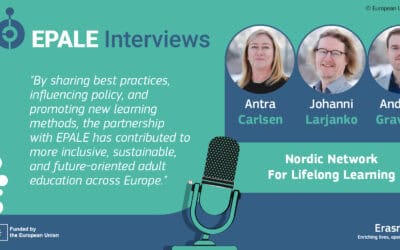
Celebrating EPALE: Nordic perspectives
Over the past ten years, EPALE has also been a place of exchange and cooperation for regional networks. See what this has meant for the Nordic countries!
An External Perspective on European Adult Learning and EPALE
This blog represents an opportunity to examine adult learning beyond Europe and consider EPALE’s potential role in the broader global adult learning landscape.
Considerations for AI-driven learning design
Explore how learning designers can navigate the promises and pitfalls of AI when planning adult education experiences.
New perspectives on continuous training in the context of the twin (digital and green) transition
The Upskilling Pathways Recommendation (2016) highlights that around 58 million adults with low basic skills in the EU need support.
Adult learners in a digital environment
Learning in an online environment requires strategic planning and continuous adaptation. How can adult educators design digital learning offers to help participants stay engaged and motivated?
Tomorrow’s work – the inclusive role of lifelong learning during the digital transition
How are small and medium-sized enterprises (SMEs) adapting to the digital age? The Work Life of Tomorrow report, published by the NVL Digital – Working Life network, takes an in-depth look at the digital transformation of the Nordic workplace, focusing on the manufacturing sector.
Flexibility and meta-skills – OECD Skills Outlook
The OECD report indicates that the digital and green transition necessitates adaptability. It thus follows that the concept of adult learning must also be subject to adaptation in order to align with the aforementioned transformations and the requirements of the economy. This post presents a summary of the report’s key findings, with the full report also available for reference.
Technological progress: an opportunity rather than a challenge
An interview with Falk Scheidig, Professor of Lifelong Learning at Ruhr-Universität Bochum, on the impact of digitalisation and artificial intelligence on adult learning.