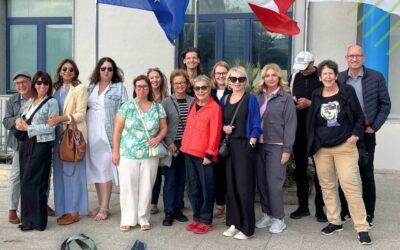
At the closing of the Szigeti Tóth János Memorial Conference held on 6 November 2025, the organizers announced that, based on the proposal of the Hungarian Folk High School Society, from 2026 onwards, 24 January will be the International Day of Adult Educators. Why 24...
adult educators
RESCALE Project Enters Pilot Phase with Successful Meeting in Italy
The RESCALE project has entered its pilot phase: the Reskilling Labs are testing new, personalized upskilling and reskilling models to support the green and digital transitions, with a special focus on adult learners with low basic skills.
How Can Erasmus+ Adult Learning Mobility Be More Effective? – New Study Identifies Barriers and Opportunities
Erasmus+ KA1 mobility programs offer valuable opportunities for adult educators and learners, but participation levels vary significantly across countries. A new study by the Tempus Public Foundation explores the cultural, structural, organizational, and individual factors that either hinder or facilitate engagement in these mobility programs.
the first Swiss-Hungarian forum on adult learning and education by ProfAdul and the SwissCham
At the end of November, the first Swiss-Hungarian forum on adult learning and education was organised by the online professional portal ProfAdul and SwissCcham Hungary (Swiss-Hungarian Chamber of Commerce).
The Swiss Model for Quality (EDUQUA) and a Train-the-Trainer System(TOT)
A brief (approximately 15 minutes) video in English with subtitles outlines the quality assurance (EDUQUA) and train the trainer system (TOT) in place for Swiss trainers.
Artificial intelligence-based trainers in adult learning
How will artificial intelligence change adult learning? An interview with media educator Harald Graschi (University of St. Gallen) on opportunities, risks and hopes.
MOOCs and micro-credentials for training adult learners
The MOOCs (open online courses) of the EBSN Professional Development Series are designed to prepare and innovatively develop the competences of professionals who teach adults or develop adult basic skills.
New perspectives on continuous training in the context of the twin (digital and green) transition
The Upskilling Pathways Recommendation (2016) highlights that around 58 million adults with low basic skills in the EU need support.
Adult learners in a digital environment
Learning in an online environment requires strategic planning and continuous adaptation. How can adult educators design digital learning offers to help participants stay engaged and motivated?
Technological progress: an opportunity rather than a challenge
An interview with Falk Scheidig, Professor of Lifelong Learning at Ruhr-Universität Bochum, on the impact of digitalisation and artificial intelligence on adult learning.